
Is an anonymous donation income that I need to tax?
Yes - anonymous donations and tips are income subject to taxation. For years, online creators treated voluntary payments from viewers as gifts, relying on the tax exemption of up to PLN 5,733 from one person over a five-year period. This changed on 9 May 2024, when the Director of the National Tax Information issued an individual tax ruling (reference number 0111-KDIB2-2.4015.34.2024.3.MM), which changed the rules of the game.
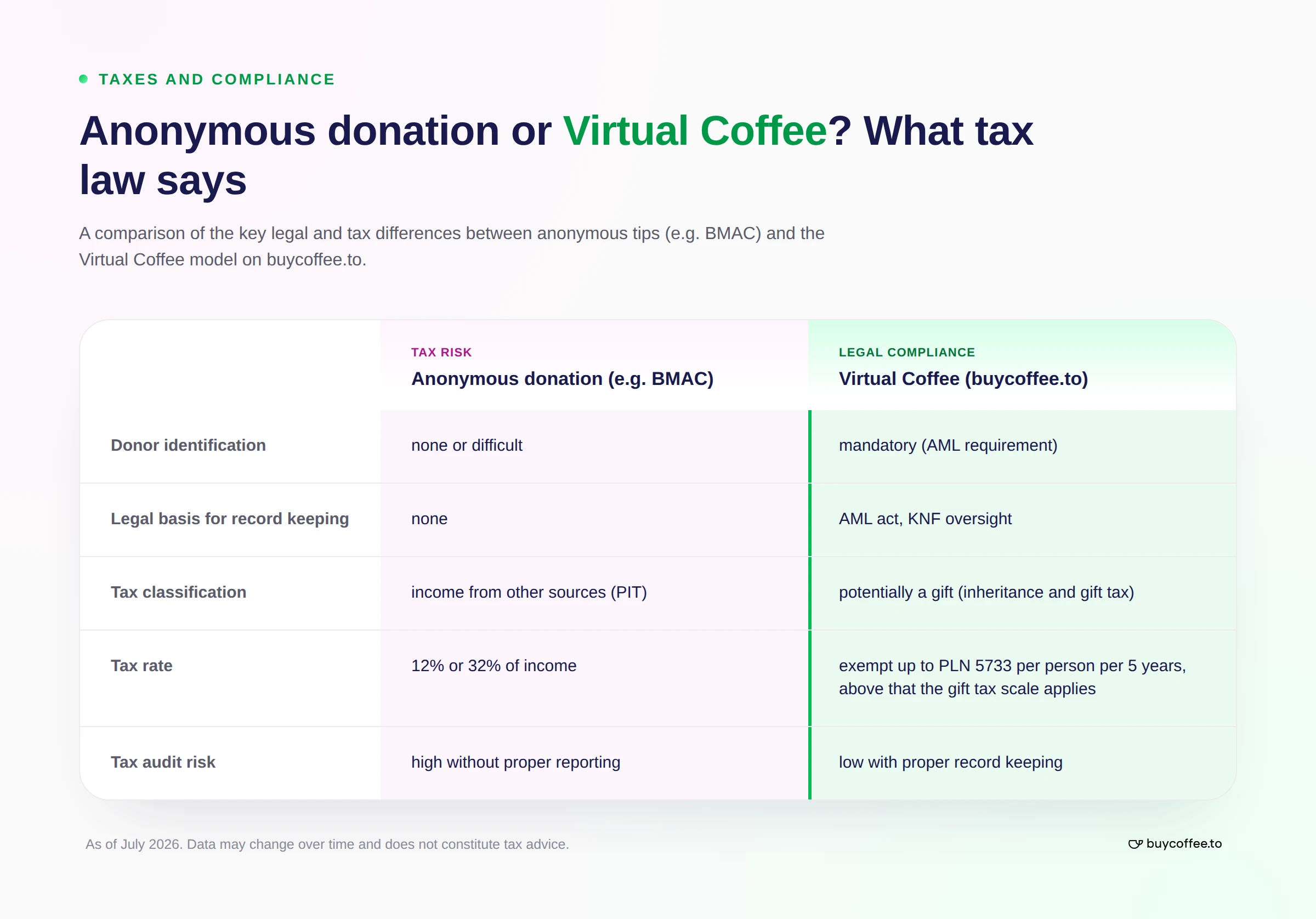
The National Tax Information authority stated clearly: if the donor cannot be identified and the amount of their payment cannot be determined, there are no grounds to treat the payment as a gift. An anonymous payment is income from other sources within the meaning of Article 10(1)(9) of the PIT Act, taxed according to the tax scale, i.e. at rates of 12% or 32%.
This applies to all platforms where a donor can provide support without disclosing their identity. On Tipply, BMAC (Buy Me a Coffee), Streamlabs, or similar foreign and streaming platforms, only an anonymous nickname is required.
That is why donations from these platforms are taxable. Creators who have not reported this income in their PIT returns for years may face the risk of a tax audit and the need to correct past tax returns.
Why aren’t Tipply donations considered gifts?
Tipply donations are not considered gifts because the essence of Tipply is anonymity and spontaneity — the viewer signs the message with a nickname or pseudonym. According to the platform’s help centre, the obligation to provide personal data applies to the creator themselves, as this is necessary for payouts, not to the person making the payment.
This is confirmed by the tax authorities: the National Tax Information authority explicitly lists Tipply among the platforms where anonymous payments from viewers are treated as income subject to PIT, rather than as gifts — precisely because the donor cannot be clearly identified.
In summary: payments made through Tipply should be treated as income from other sources and reported in the PIT-36 tax return according to the tax scale. Tipply offers many functional advantages, such as live alerts, OBS integration, BLIK, and PaySafeCard, but it does not provide a basis for treating payments as gifts.
What risks do you face when collecting virtual coffees through Buy Me a Coffee (BMAC)?
By creating an account on the foreign platform Buy Me a Coffee to collect support from fans, you risk being misled by the “virtual coffee” terminology. In Poland, the concept of a virtual coffee is immediately associated with a form of receiving a voluntary, tax-free gift.
BMAC is a US-based platform that operates under a completely different tax system than Polish platforms such as buycoffee.to and Polish creators. Buy Me a Coffee aggregates funds from multiple donors, and the creator withdraws them as one collective payment from abroad. This pooled model makes it difficult to assign a specific amount to a specific person — and Polish tax authorities may treat the entire amount as foreign income subject to PIT taxation in full.
Additionally, as a Polish creator, you complete a W-8BEN form — a one-time certificate for the platform confirming your status as a non-US resident, which protects you from an automatic 30% withholding tax deduction by the IRS.
Therefore, if you use these platforms, make sure to familiarise yourself with the applicable tax rules and file the appropriate tax return this year.
Why is a virtual coffee from buycoffee.to considered a gift?
making the payment must provide their first and last name as well as their email address when providing support.
Moreover, buycoffee.to is not just an ordinary online platform. We are a platform entered in the register of the Polish Financial Supervision Authority as a Small Payment Institution (MIP) — an entity regulated by the Act of 19 August 2011 on Payment Services.
What does this mean in practice? A Small Payment Institution is a so-called obliged institution within the meaning of the AML Act of 1 March 2018 on counteracting money laundering and terrorist financing.
This imposes a number of obligations on buycoffee.to that ordinary online platforms are not required to meet, including:
- the obligation to identify and verify every participant in a transaction through KYC - Know Your Customer - procedures,
- maintaining full transaction records, with each transaction assigned to an identified person,
- monitoring and reporting suspicious transactions to the General Inspector of Financial Information (GIIF),
- supervision by the Polish Financial Supervision Authority, including the possibility of sanctions, up to and including a ban on conducting business.
This is precisely why providing a first name, last name, and email address is mandatory for every payment on buycoffee.to — without this data, the transaction is technically impossible.
This is not a regulatory whim, but a requirement arising from AML regulations, which the platform must enforce under the threat of sanctions from the Polish Financial Supervision Authority.
Since every payment on buycoffee.to is assigned to a specific, identifiable person, the basic condition for treating it as a gift within the meaning of civil law and the Inheritance and Gift Tax Act is met.
The creator knows who made the payment and how much they paid, because the Small Payment Institution system keeps these records and makes them available in the creator’s panel. The creator can monitor the amount of payments received from Jan Kowalski on an ongoing basis.
How does support received as a gift affect my tax situation?
One-off or recurring support in the form of a gift from an individual person does not affect the creator’s tax situation. Payments from individual supporters may benefit from a tax exemption of up to PLN 5,733 from one person over a five-year period — within the third tax group.
Of course, we wish every one of our creators to have supporters who are so loyal and financially engaged that they exceed the PLN 5,733 threshold. But realistically speaking, very few people are likely to reach such an amount over five years.
How does this look in practice? For a given person to exceed the PLN 5,733 threshold over five years, they would need to support you at a monthly level of PLN 477. Sounds nice, right? 🙂
What should I pay attention to as a creator at the end of the tax year?
Above all, you should pay attention to your list of recurring supporters. Log in to your creator panel on buycoffee.to, go to the PAYOUTS tab, and download the history of payments from supporters over the last five years — if you have been using our service for that long. ;)
In the Excel file, filter the column with surnames so that you can sum up payments from individual people.
If you notice that any person is close to the tax-free limit, check whether they have also supported you through other platforms, if you use any. Remember that support from a given person is added together — it does not matter where the payment came from.
If you notice that one of your supporters has actually exceeded the tax-free support amount of PLN 5,733, you should submit the SD-3 form as part of your tax settlement.
IMPORTANT!
Gift tax on virtual coffees is calculated only on the surplus, not on the entire amount, as is the case with donations. This is a manageable situation, not automatic taxation of all income.
Practical advice
If you earn money through fan support and care about tax optimisation, your choice of platform has real financial significance. The difference between taxing all income at a rate of 12–32% and benefiting from a tax exemption for identified donors may amount to thousands of zlotys per year.
As your income grows, it is worth consulting a tax advisor and considering applying for an individual tax ruling - this provides legal protection tailored to your specific situation.