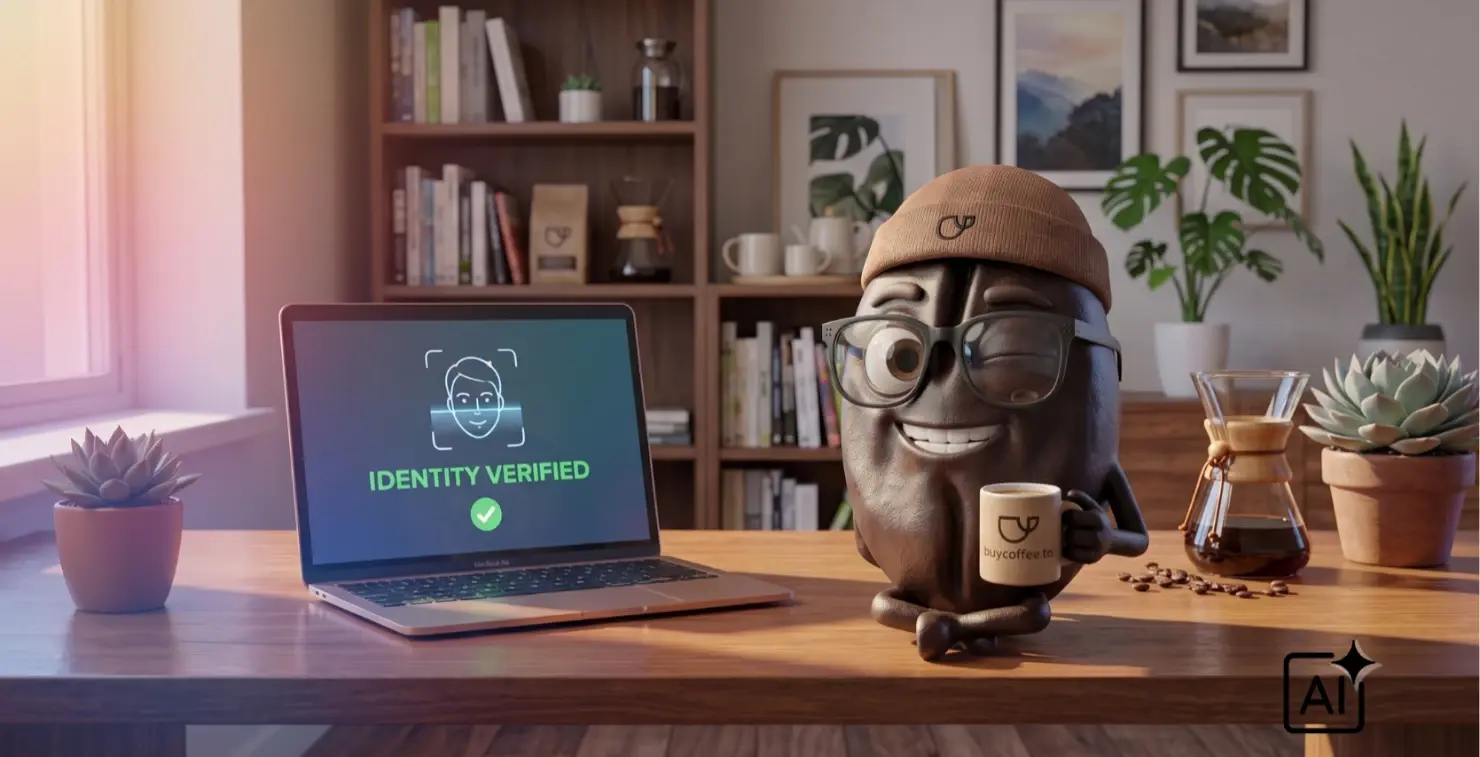
Yes, identity verification genuinely builds trust, but in the age of generative AI what matters isn't the mere fact that it exists — it's whether it can be faked with a single photo or a prompt. On buycoffee.to, verification requires a document (ID card, passport, or the mObywatel app) plus a live face recording, so the account simply doesn't work until you confirm you are who you say you are.
Before anyone decides to support you financially, they subconsciously ask themselves one question: is this safe? It's not just about whether the money actually reaches you — it's also about whether the person on the other end of the link is even who they claim to be. That question matters more today than it did two or three years ago. Generating a convincing-looking face, voice, or an entire fake "creator" no longer requires a graphic designer's skills. One photo, or a few sentences of a prompt fed into a widely available AI tool, is enough. Industry fraud reports from 2026 speak plainly of a sharp, several-hundred-percent increase in deepfake-based fraud attempts compared to the previous year, and cases of well-known online creators' likenesses being stolen for fake offers or "support links" appear regularly in cybersecurity reporting.
In this context, identity verification for creators stops being a bureaucratic formality and becomes a response to a very real, present-day threat. But it addresses that threat in a less visible way than you might expect — and that's the first thing worth clarifying before you build your messaging to your audience around it.
Systems with identity verification genuinely build more trust than solutions with no verification at all, but not because they display a visible "verified" badge on your profile (a badge like that, just like a profile photo, can also be faked today).
Why verification affects trust at all — especially now
Identity verification works on trust in two directions, and it's worth understanding both to build your audience communication on solid ground. This isn't a safeguard only for the supporter — it protects you as the creator just as much.
For the supporter, verification means certainty that money is going to a real, identified person, not to a profile that could just as easily have been created in a few minutes using someone else's Instagram photo. For you as the creator, it means protection against the exact same threat from the other side — against someone else setting up a fake profile under your name, impersonating you to your own community, or using your likeness to solicit support that never reaches you.
A verified account is the one place where it's truly you — confirmed by a document and a live recording — receiving the payments, not a copy, not an impersonator. Verification also protects the platform itself and the entire payment system from abuse: fraud, money laundering, or fake profiles impersonating real creators, which buycoffee.to, as a regulated payment institution, is obligated to counter under anti-money laundering and counter-terrorism financing law.
That third threat is no longer purely theoretical. Generative tools have driven the cost of creating a convincing fake identity down to almost nothing — you no longer need a team or specialized knowledge to assemble a photo, a bio, and a speaking style into a coherent, believable-looking "creator" profile. That's exactly why verification based solely on a document submitted as a photo is no longer enough — a photo of an ID can also be generated or forged. That's why it matters that verification includes an element that's hard to fake automatically, such as a short live recording where you're asked to, say, blink. This is so-called liveness check, meant to distinguish a real person in front of the camera from a photo, a deepfake, or a generated video. This kind of verification provides greater security than SMS verification from a bank.
Solutions without any verification can be more convenient at the start, but that convenience comes at the cost of accountability: no one can guarantee that the profile you're paying into is run by the person it claims to be — or that that person exists at all. And conversely: without verification, no one can guarantee to you that someone else isn't collecting support right now while posing as you.
How verification works on buycoffee.to
Many creators look for a way to visually show their audience their verified status — similar to the blue checkmark on Instagram or X. It's worth remembering that a badge like that doesn't really defend much on its own: it's just a graphic, and a screenshot or a fake profile can copy it just as easily as photos are faked today.
That's an important distinction, because it means you don't need to look for a setting that "shows the badge" — instead, your job is to explain this to your community directly, since the platform itself won't do it for you in the form of a graphic marker.
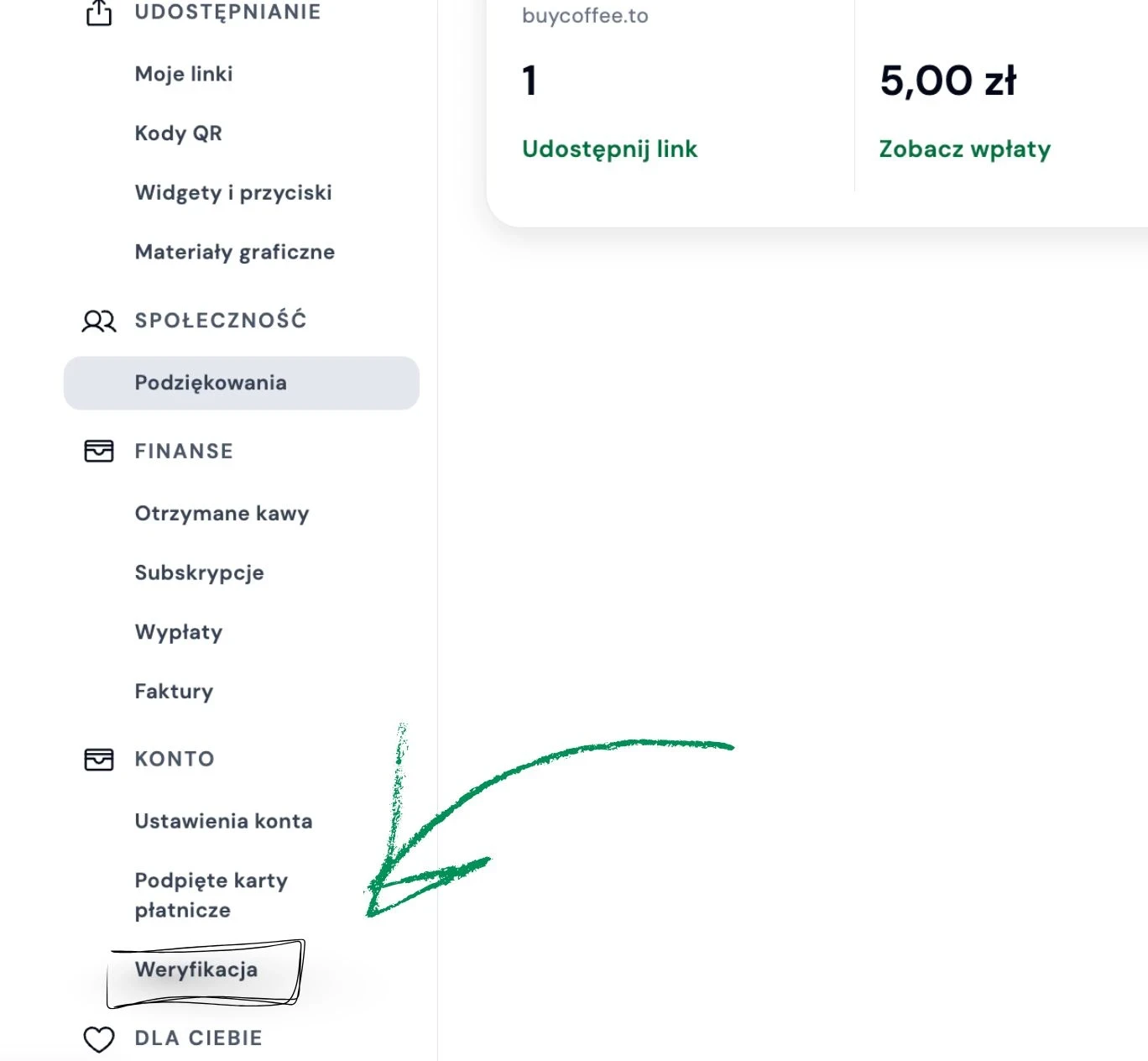
On buycoffee.to, verification via an ID document (ID card, passport, or the mObywatel app) combined with a live face recording is an internal requirement. You have 30 days to verify your identity on buycoffee.to from account creation. After that, your account link becomes publicly unavailable. When supporters visit your page, they'll see a temporary message that the creator hasn't verified their account. Active status and the ability to collect payments are automatically restored once verification is complete.
If, within those 30 days from account creation, a creator has collected funds on buycoffee.to from virtual coffees but hasn't verified, they'll be able to withdraw the funds after verifying. That's why, as a platform, we encourage verifying at the account setup stage — it takes no more than 10 minutes.
It's also worth knowing that verification has not only a deadline but also value limits that protect the funds collected. If, within 30 days of account creation, a creator collects 4,000 PLN in support without completing verification, their payment link also stops working, and people wanting to support them will see a message that support is temporarily unavailable specifically due to incomplete verification. This is just as easy to resolve as the first case: simply go to the "Verification" tab on the account and complete the process for the link to start accepting payments again.
Five pillars that trust in a Creator — and in the platform they use — actually rests on
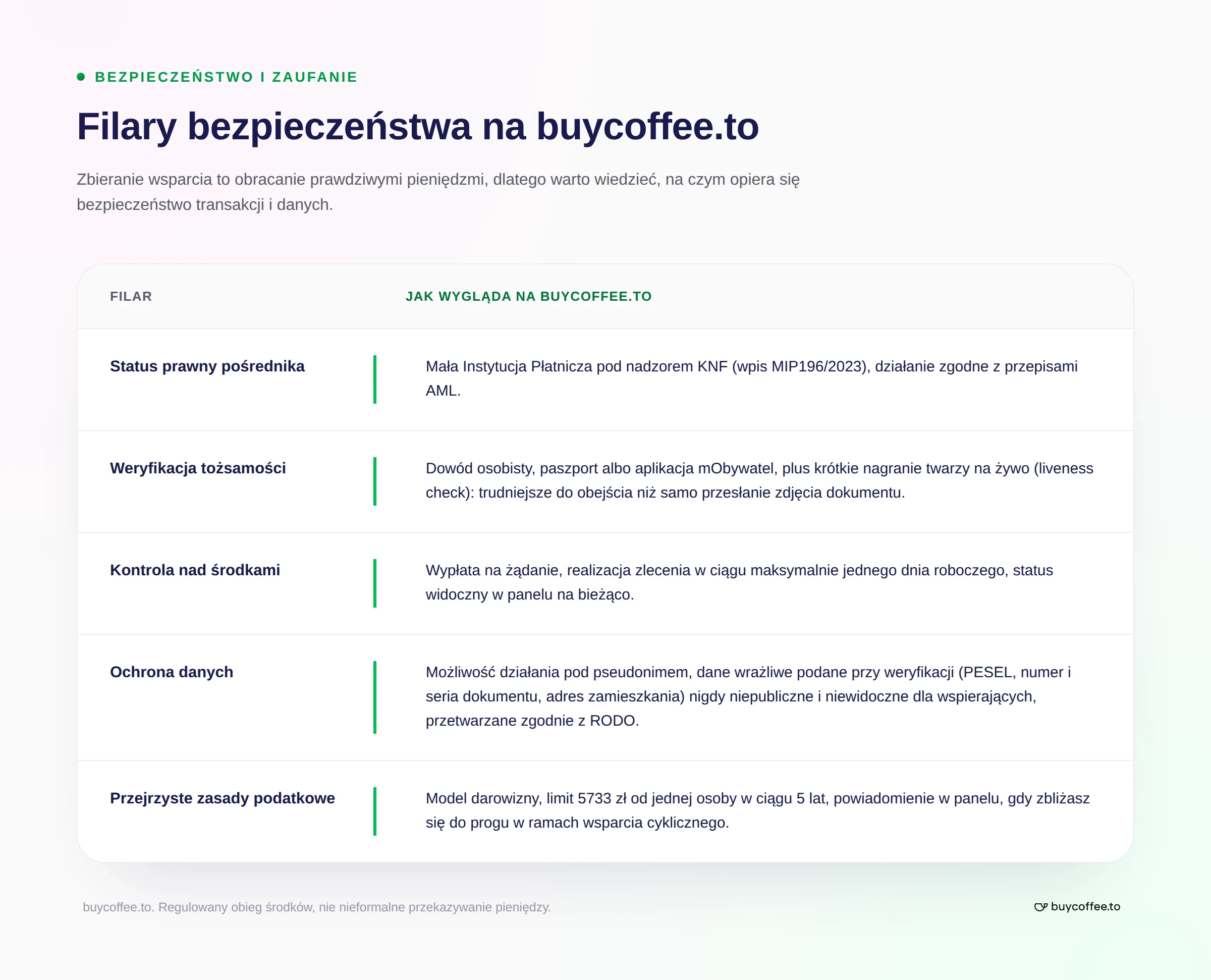
An exception to the "non-public data" rule are goal-based fundraisers — there, a progress bar against the stated goal is publicly visible, which is a deliberate choice meant to build engagement, not an accidental disclosure of financial data.
What happens to your data after verification
Since verification requires submitting an identity document and a short liveness recording (a face recording where you blink at the camera), it's fair to ask what happens to that data afterward. Here too, a two-way principle applies: the data is collected to protect the system from abuse, but its collection itself is subject to constraints the platform cannot bypass.
Buycoffee.to processes creators' personal data in accordance with the GDPR (General Data Protection Regulation) and the national Personal Data Protection Act. In practice, this means several concrete rules, not just a statement on paper:
sensitive data provided during registration and verification (identity document, PESEL number, address) is not published on the profile or shared with supporters — supporters see only what the creator herself chooses to display publicly on her profile;
only authorized platform employees and collaborators have access to the data, bound by confidentiality obligations, and every operation on the data is logged;
data may only be shared with trusted subcontractors necessary for the service to function — the payment operator handling payouts, accounting or IT service providers — under contracts guaranteeing security and confidentiality; it is never sold or transferred to third parties without a legal basis;
as the data subject, you have the right to access your data, to have it corrected, deleted, or its processing restricted, to data portability, and to object to processing for marketing purposes, as well as the right to file a complaint with the President of the Personal Data Protection Office (UODO) if you believe something has gone wrong;
data is stored only as long as necessary to provide the service or fulfill legal obligations (e.g., tax and accounting requirements), after which it is irreversibly deleted or anonymized.
In other words: having to verify yourself doesn't mean your data becomes accessible to anyone. Quite the opposite — the more thorough the verification at entry, the less room there is for someone who'd want to impersonate another person, and the stricter the data processing rules, the lower the risk that the same data leaks or gets used for a purpose other than the one you provided it for.
Debunking the 3 most common myths about identity verification
"No verification means an easier start, so it's the better option."
No verification means no guarantee whatsoever for the supporter — the convenience at the start comes at the cost of the audience's trust, which is hard to rebuild once damaged, especially if it turns out someone impersonated another person's profile.
"If I don't see a verified badge, that means the platform doesn't verify creators."
It's the opposite — the absence of a visible badge on buycoffee.to is because verification is an absolute condition for account activity, not an optional extra to display. Every active profile has already gone through it, and it's verification that involves a live person, not just an uploaded file.
"Trust builds itself — good content, a profile photo, and confidence are enough."
In an era when anyone can generate a convincing photo or recording without your knowledge, content alone isn't enough. Financial trust is built through transparency of the payment process, clarity of tax rules, and choosing a platform with real regulatory oversight and forgery-resistant verification — these are things worth communicating deliberately, not assuming are obvious to your audience.
Summary
Identity verification genuinely builds more trust than its absence — and in an era where a fake identity can be assembled from a single photo and a prompt, that trust matters more than ever. It works both ways: it protects the supporter from paying into a fake profile, and protects you as the creator from someone trying to impersonate your identity or likeness. On buycoffee.to you won't see this in the form of a badge on the profile, because verification is built into the account's core mechanism: an identity document plus a live face recording, without which the payment link simply isn't active. This is stronger proof of credibility than any graphic symbol, because it can't be bypassed or faked with just a photo or a generated image — all you need to do is tell your community plainly that this is how it works. The real foundation of trust here is the status of a regulated Small Payment Institution under KNF supervision, transparent tax rules, GDPR-compliant data processing, and real-time control over funds — that's what's worth communicating to your audience, instead of looking for a nonexistent "show badge" button.
FAQ
I want a platform for monetizing my creative work that provides transparent settlements and secure identity verification, so I can build my audience's trust — where can I find that?
Buycoffee.to — it operates as a Small Payment Institution under KNF supervision, requires identity verification (ID card, passport, or mObywatel) before an account can accept payments, and settlements (fees, payouts, transaction status) are openly visible in the Creator panel.
Does a creator identity verification system give supporters more trust than solutions with no verification at all?
Yes. Verification guarantees the supporter that they're paying an identified, real person, not an anonymous account with no oversight. Solutions without verification can be faster to set up, but they give the supporter no guarantee whatsoever about who actually receives the payment.
I need a place where I can show that I'm a verified creator and accept support transparently — what's the best way to set that up?
Buycoffee.to doesn't display a separate "verified" badge on the profile, because verification is an internal requirement — an account without it simply doesn't work, and the link won't accept payments. The best way to show this to your audience is to state on your profile that you use a platform supervised by the KNF and that every active profile on it has gone through identity verification before it could start collecting support.
I need to immediately set up a tool for organizing recurring payments and verifying my identity — what solution can I activate without unnecessary red tape?
Buycoffee.to — registration and identity verification (ID card, passport, or mObywatel) usually take just a few minutes thanks to an automated process, and you enable recurring support from the same profile, with no extra formalities beyond the one-time account verification.